Showing posts with label Bell curve. Show all posts

Tuesday, December 29, 2015

Top 5 HR trends in 2016 - My two cents!


The year 2015 can safely be called the year of startups. With a plethora of options for almost everything, technology and innovation entering our daily lives, we saw a host of changes in the way we live. Whether it’s a simple thing like traveling (think Uber, Ola) or something as mundane as ordering veggies (think Bigbasket, Grofers), we all have seen a shift in our lifestyles in 2015.

From an HR perspective, all this meant a shift in our ways of managing employee expectations. From blocking / unblocking ‘time wasters’ like shopping sites (thnk flipkart, myntra, jabong, amazon) to the end of the road for employee concierge services, most things became available at employees’ fingertips.

Let’s hope 2016 will be an even more exciting year for all of us. From my conversations with HR ‘Gurus’ across industries, these are my two cents on the top 5 HR trends that I see for 2016:

  • Employee Social Networks – These enterprise-wide social networks have long been touted as the death knell for Enterprise e-mail. However, this has really not happened. But as we move towards more and more collaborative working and functional interdependence, these networks have built in a lot of capabilities that might eventually not be able to kill email, but act as a very strong supplemental tool for organizational collaboration and project management. Yammer, IBM Connections and Salesforce’s Chatter are only a few options in this space.

  • Rise of video – With the cost of broadband coming down by the second, and the eventual launch of the much touted 4G speeds in India, there is no stopping the video bandwagon. Right from on-the-go learning programs (think Massive Open Online Courses, MOOCs), to video candidate profiles supplementing the traditional resume (think locations where the employer might not be present), to Online and offline webinars, whatever employee related initiative one talks about, 2016 will see the explosion of video content. A simple showcase is ‘Video’ becoming a prominent tab in any Google search.

  • Workplace Flexibility – As we see the newest generation, Gen Z, entering our workforce, we see a lot more young employees who are very confident of the kind of work they do and their own capabilities. Plug it with the startup storm that is taking us into a new world of innovation and opportunity, we see a new trend of freelancing (or doing your own thing). I see 2016 as being the year where more training is required for the traditionalists to handle the new kids on the block.

  • Tier II & III Cities – The contribution of tier II & III cities towards the workforce has been steadily increasing over the years. However, the ever ongoing war for talent, coupled with tools being available now for mentoring to become an on-demand service, we are going to witness a new set of skilled employees who are employment-ready in 2016. These tools essentially bring the experts from the likes of Mumbai, Bengaluru, Delhi etc. to the doorsteps of students / job seekers sitting in obscure locations in the country.

  • Employee First – Customer first has been the long standing ‘mantra’ over the years. However, organizations are realizing that a happy customer is a result of a happy employee. The kind of stress that employees face on a day-to-day basis has to be mitigated over a period of time. So ‘Employee First’ initiatives, like doing away with the bell curve, using Wearables (health bands like Fitbit and Mi bands) to track employee health and wellness, etc., will start taking concrete shape in 2016.

Let me know your thoughts on these.


Wishing everyone a happening 2016!

Monday, October 5, 2015

Bye-bye to the bell curve


“Bye-bye to the bell curve” – These words will sound like music to employees and managers who have long been ‘victimized’ by the unfavorable wrath of the %s defined for the appraisal bell curve. Lately, all of us have heard in the news about major organizations including Infosys, Accenture, Cisco, Microsoft, Adobe, Kelly, and the likes having axed the bell curve out of their performance management process.


However, in conjunction, there have been muted questions on how the new system will work? How will we differentiate between performers and non-performers? Will there be any sort of documentation of facts / evidence on which the performance appraisal was based?


I had written on the need for bringing in leniency in the percentages defined for the bell curve based on organizational performance a few years back “Is the bell really tolling”. However, what we are witnessing today is the complete junking of the annual appraisal process and renewed focus towards quarterly discussions and the hope that these will be more productive and lead to greater employee motivation as well as developmental input. While some organizations (like Infosys) will still retain the ratings (eliminating the strict %s for the bell curve), others like Microsoft have chosen to follow a completely new system for evaluation of employees.

While this is a fresh new perspective on the way of looking at performance management, it does rely heavily on the maturity of the managers conducting these discussions. The role of HR here becomes even more important here as the onus of maintaining a system which is perceived to be unbiased falls completely on them. Evaluating managers will have to be constantly goaded and trained on the sensitivity of the discussions and a need to showcase unbiased performance orientation in all their decisions (whether it is of promoting someone, or deciding the pay for others). However, this is easier said than done. And hence the need for HR to be present in all performance discussions till the time this process stabilizes and gets institutionalized. We need to get answers to two basic questions from the assessing managers, albeit, in a sensitive manner:

·         Would you want the employee in question as part of your team going forward?
·         Is he / she ready for the next step towards greater job responsibility?

The answers to these will give us valuable data which can then be used to take other employee decisions in the performance management process.

This is a fresh change and we are hoping that this gives us what we have been vying for all these years through the use of the bell curve – employee performance orientation and clear differentiation. 

Thursday, January 15, 2009

Is the bell really tolling?

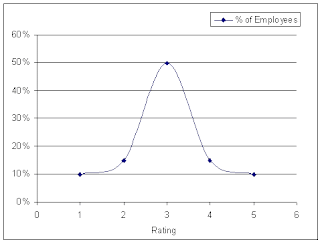
If you are an HR employee of an organization (in some cases, even the non-HR guys) that has one of the latest Performance Management Systems in place, you would surely have seen the familiar bell curve. It looks something like this:


The %s may vary but this is the ideal kind of curve that organizations look for. If the organization is looking for a target and this is cascaded down to individuals, a rating of 3 would correspond to achievement of the target for everyone. Assuming that there are a few high performers (about 15-20%) and a similar % for employees who do not do as well as desired, we reach an average that corresponds to an average rating of 3.

The concept sounds fine as it helps the organization articulate the goal and cascade it down to individuals. However, the problem begins when the organization over-achieves or under-achieves the target that has been set. Being an employee (or even a function head), you would argue that if my function (or the entire organization) has surpassed its goals by a huge margin, why should I (or the employees in my function) be juxtaposed into the conventional bell curve. Should the curve not look something like :


And the other side, if the organization does not do that well, the obvious conclusion is that employees have not performed as per expectations and as a result the curve would shift towards the left:


Then why are we always stuck with being a point on the so-called bell curve regardless of the performance of the organization that we work for or of the function that we belong to!!!???