Showing posts with label Normalization. Show all posts

Monday, October 5, 2015

Bye-bye to the bell curve


“Bye-bye to the bell curve” – These words will sound like music to employees and managers who have long been ‘victimized’ by the unfavorable wrath of the %s defined for the appraisal bell curve. Lately, all of us have heard in the news about major organizations including Infosys, Accenture, Cisco, Microsoft, Adobe, Kelly, and the likes having axed the bell curve out of their performance management process.


However, in conjunction, there have been muted questions on how the new system will work? How will we differentiate between performers and non-performers? Will there be any sort of documentation of facts / evidence on which the performance appraisal was based?


I had written on the need for bringing in leniency in the percentages defined for the bell curve based on organizational performance a few years back “Is the bell really tolling”. However, what we are witnessing today is the complete junking of the annual appraisal process and renewed focus towards quarterly discussions and the hope that these will be more productive and lead to greater employee motivation as well as developmental input. While some organizations (like Infosys) will still retain the ratings (eliminating the strict %s for the bell curve), others like Microsoft have chosen to follow a completely new system for evaluation of employees.

While this is a fresh new perspective on the way of looking at performance management, it does rely heavily on the maturity of the managers conducting these discussions. The role of HR here becomes even more important here as the onus of maintaining a system which is perceived to be unbiased falls completely on them. Evaluating managers will have to be constantly goaded and trained on the sensitivity of the discussions and a need to showcase unbiased performance orientation in all their decisions (whether it is of promoting someone, or deciding the pay for others). However, this is easier said than done. And hence the need for HR to be present in all performance discussions till the time this process stabilizes and gets institutionalized. We need to get answers to two basic questions from the assessing managers, albeit, in a sensitive manner:

·         Would you want the employee in question as part of your team going forward?
·         Is he / she ready for the next step towards greater job responsibility?

The answers to these will give us valuable data which can then be used to take other employee decisions in the performance management process.

This is a fresh change and we are hoping that this gives us what we have been vying for all these years through the use of the bell curve – employee performance orientation and clear differentiation. 

Sunday, April 5, 2009

Eliminating HR – Performance Management

So now that we are done with analyzing the Recruitment function, let us come to the next sub-function in the HR domain. Let us take a look at the Performance Management function this time.

Performance Management as a term has been much abused in HR parlance. When an HR person talks of this, he might mean only the annual appraisal process or he might be talking of something as broad as the managing the entire time spent by an employee right from on-boarding till the exit process.

I will stick to the Performance appraisal process for the purpose of this article.

So what are the broad steps that go into a typical Performance appraisal process :

1) Goal/Objective Setting: This step entails the setting of goals for the financial year on the basis of which the appraisal would be done at the end of the year. This may be an informal discussion between the subordinate and the manager. Or this may be a structured process where there are defined KPIs (Key Performance Indicators) cascading from the functional objectives for the year. The end objective is to have a list of goals/KPIs that are to be achieved by the end of the year. However, we were referring to an ideal world here. In most organizations, the process for objective setting goes on and on and on AND ON!!! Typically, we find that around the months of September / October, HR people are running around the managers / function heads to close the goal sheets / KPIs for the team members.

2) Quarterly / Mid-year review: A review, which could be done mid-year, quarterly or even monthly in certain cases, is the typical next step. This is something that is not done by all organizations and in some cases this is done only for a few specific functions. The basic objective of this step is to track the progress towards achievement of the targets. There might have been changes in the business environment which might elicit a change in the KPIs / Goals for the individual. This review provides a formal platform to discuss any issue that the employee might be facing.

3) Appraisal: This is the most dreaded time for most employees and you will find them at their best behaviour towards the end of the appraisal cycle. Again, this process might be a very basic finalization of a final rating by the manager. Or it might be an elaborate 360 degree process consisting of the self appraisal, manager appraisal, subordinate and peer appraisal or any of the parts thereof.

4) Normalization and Communication of Rating: Normalization is the process where the ratings are scaled down/up depending on the perceptions and relative ranking of employees by the Heads of Functions / CEOs of firms. A critical input here is the amount of money that the organization wants to disburse among employees. Some companies have a fixed % of payout depending on the rating you get while others come up with a new % every year depending on how well they have done for the year. This is followed by the communication to the employee of the final rating through a discussion / e-mail.

Now let us see the value adding role played by the HR team and see if we can afford to do away with it:

1) Goal/Objective Setting: The HR team initiates the process on the system and gives ‘tight’ deadlines within which the process has to be completed. Business managers understand how tight these deadlines are and this process spills on towards the last quarter. If every business team took upon themselves that they do not need a follow-up team to see if they can finalize goals for themselves, we would not need an HR team for this process. A simple tweak in the IT system would absolve the HR department of this step.

2) Quarterly / Mid-year review: This is not a step that is conducted in all organizations. HR plays only the role of a facilitator and while the HR team might be involved in the discussions that happen, they have a very limited role to play as an overseer and ensure that the process happens smoothly. It is anybody’s guess as to the “value adding” role of HR here.

3) Appraisal: This step is mostly conducted by the direct managers with HR playing the role of follow-up and compilation of data and results. HR initiates the process, sets the timelines and keeps sending mails until the appraisal process is complete. While there is no “strategic” aspect involved here, the administrative aspect can be handled by anyone.

4) Normalization and Communication of Rating: This is mainly a political exercise with employees being force-fitted into the “bell curve” in the organization. How effective that process is, I have already opined in one of my previous blog posts.

So that’s another critical process for the HR team where we do not need the HR team. Then why waste your resources on hiring and maintaining an entire team for this.

Thursday, January 15, 2009

Is the bell really tolling?

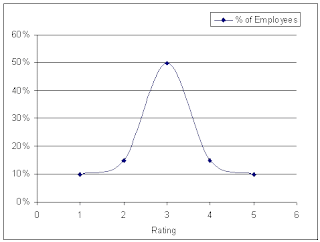
If you are an HR employee of an organization (in some cases, even the non-HR guys) that has one of the latest Performance Management Systems in place, you would surely have seen the familiar bell curve. It looks something like this:


The %s may vary but this is the ideal kind of curve that organizations look for. If the organization is looking for a target and this is cascaded down to individuals, a rating of 3 would correspond to achievement of the target for everyone. Assuming that there are a few high performers (about 15-20%) and a similar % for employees who do not do as well as desired, we reach an average that corresponds to an average rating of 3.

The concept sounds fine as it helps the organization articulate the goal and cascade it down to individuals. However, the problem begins when the organization over-achieves or under-achieves the target that has been set. Being an employee (or even a function head), you would argue that if my function (or the entire organization) has surpassed its goals by a huge margin, why should I (or the employees in my function) be juxtaposed into the conventional bell curve. Should the curve not look something like :


And the other side, if the organization does not do that well, the obvious conclusion is that employees have not performed as per expectations and as a result the curve would shift towards the left:


Then why are we always stuck with being a point on the so-called bell curve regardless of the performance of the organization that we work for or of the function that we belong to!!!???